
Assess & Release: the full-body approach to pregnancy support
The assessment and hands-on techniques I teach providers — so you can stop treating symptoms and start releasing what’s actually restricted. Walk away with skills you can use with your next pregnant client.
Tell me where to send it
Most providers are scared to touch pregnant bodies. But pregnant clients need skilled, confident care more than anyone else.
The problem is that most care focuses only on the pelvic floor. Pregnancy affects the entire fascial system — ribs, abdomen, hips, thoracic spine. Miss the restrictions across the whole body, and you miss the root of dysfunction.
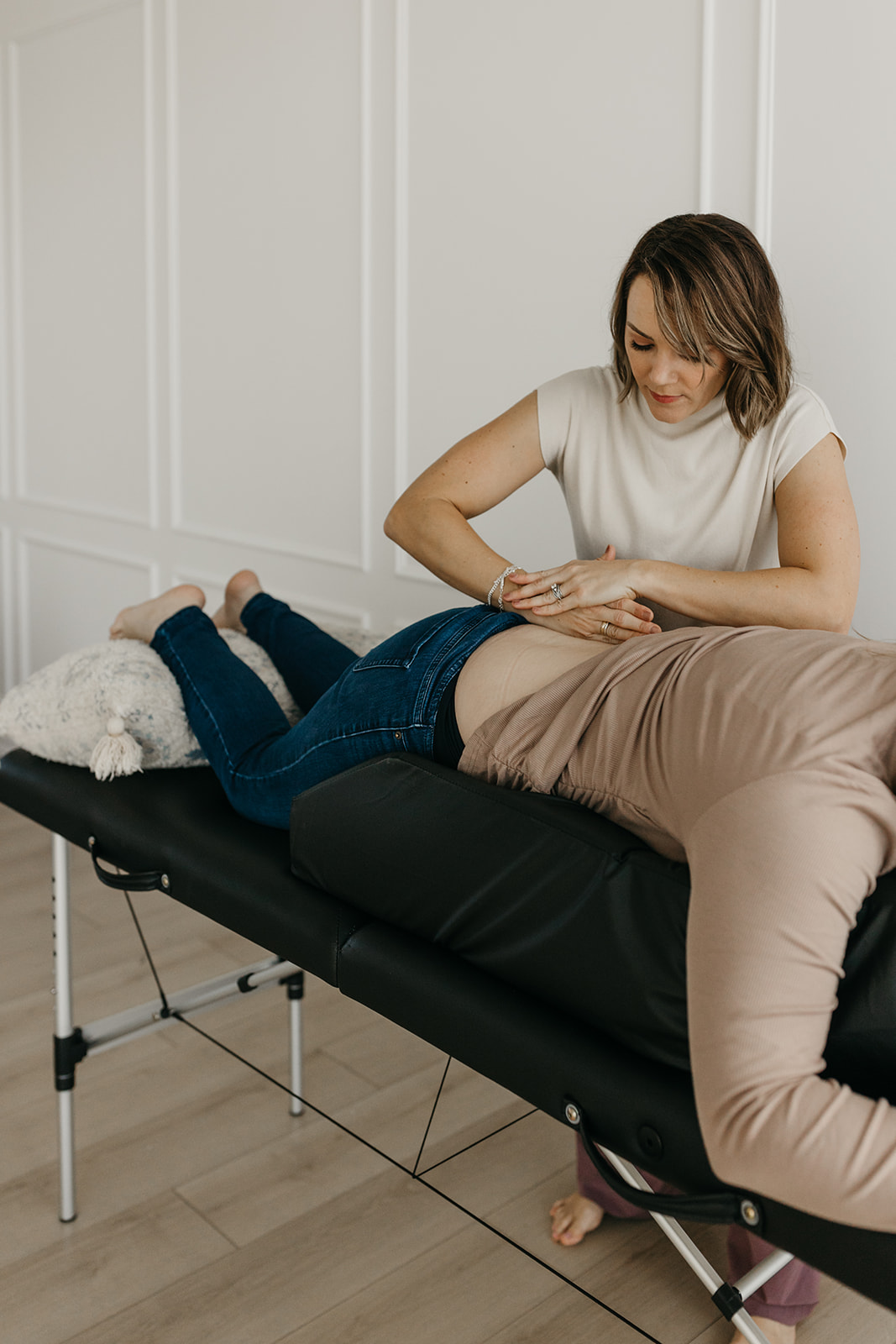
Real assessment & treatment, demonstrated live
The 3-question framework
Where are the restrictions? What muscles are affected? Does this area need strength, mobility, or both? The system that changes every treatment.
Rib & thoracic release
Assess rib mobility, release the intercostals, and reinforce with positioning — so the core canister isn’t compressing the pelvic floor.
Pelvic floor & hip flexors
The connection most providers miss: why “just do your Kegels” makes an overactive pelvic floor worse — and the release-restore-rebuild sequence that works.
Made for licensed providers
Physical & occupational therapists, massage therapists, midwives, nurses — anyone who wants to work with pregnant and postpartum bodies skillfully and confidently.

Dr. Hailey Miller, PT, DPT
Pelvic health physical therapist and founder of the Belly Balancing Method. Hailey teaches providers to see the pregnant body as an integrated whole — assessing restrictions across fascial lines, releasing what’s stuck, and empowering clients with the tools to maintain their own progress.
Her mission is simple: turn provider hesitation into confident, skilled care that pregnant and postpartum clients actually deserve.
Questions providers ask me
Who is this workshop for?
Licensed providers who treat — or want to treat — pregnant and postpartum clients: physical therapists, occupational therapists, massage therapists, midwives and nurses. You do not need prior pelvic health training to follow along.
Is it safe to do manual therapy on a pregnant client?
Yes, when you assess first and stay within your scope. Most hesitation comes from missing training rather than real risk. In the workshop you will learn what is safe by trimester, which positions to use, how to modify for comfort, and when to refer out instead.
Why is pregnancy care about more than the pelvic floor?
The pelvic floor is the base of a pressure canister it shares with the diaphragm, abdominal wall and deep back muscles. When the ribs, thoracic spine or hips are restricted, downward pressure on the pelvic floor increases — so treating the pelvic floor in isolation misses the source of the dysfunction.
Should you stretch an overactive pelvic floor?
No. An overactive pelvic floor is already holding tension, so aggressive stretching or added Kegels reinforce the guarding. The order that works is release the tissue, restore mobility with breath, then rebuild strength lightly once the system can accept load.
What do I get, and what does it cost?
It is free. The session runs about 45 minutes, is prerecorded so you can watch anytime, and includes the 3-Question Assessment cheat sheet to download and keep.
Are CEUs included?
This free workshop is educational and does not carry CEUs. [Edit or delete this answer to match your accreditation — and update the matching answer in your FAQ schema if you change it.]
Save your seat — it’s free
75 minutes of real assessment and treatment demos, plus the 3-Question Assessment cheat sheet to keep. Watch anytime.
Save my seat →